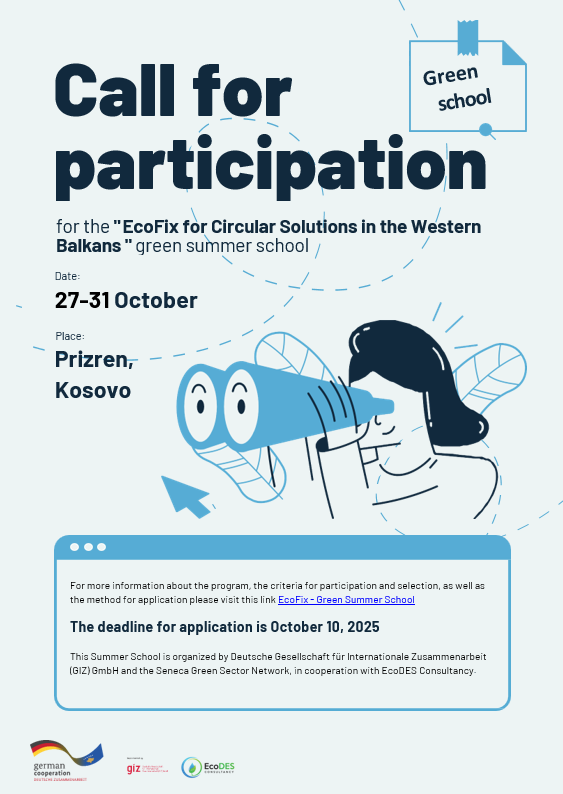
Call for participation for the "EcoFix for Circular Solutions in the Western Balkans" green summer school


Concept Note: Green Summer School – EcoFix for Circular Solutions in the Western Balkans
Title: Green Summer School – Empowering Youth Through EcoFix: Circular Skills for a Green Transition
Duration: 5 Days
Location: Kosovo
Participants: 20–25 young students from Western Balkans (Kosovo, Albania, North Macedonia, Montenegro, Serbia, Bosnia & Herzegovina)
Background
Electronic waste (e-waste) is one of the fastest growing waste streams globally and a critical environmental issue in the Western Balkans. At the same time, youth across the region face high unemployment rates, limited access to green skills, and underrepresentation in climate and circular economy initiatives. There is also a significant gender gap in vocational and technical fields.
EcoFix addresses these challenges through a hands-on, inclusive, and scalable repair training approach. By focusing on electronic repair and the principles of the circular economy, the model empowers youth—especially women and underserved groups—with skills for self-employment, sustainability, and community impact.
The Green Summer School is intended to integrate the EcoFix model into a 5-day regional training event, aligned with the priorities of the GIZ and SENECA Networks around the topics of circular economy.
Objectives
- Equip 20–25 students and youngsters with hands-on skills in electronics repair, diagnostics and sustainable business models
- Raise awareness on e-waste and circular economy aligned with the EU WEEE Directive
- Promote gender equality and social inclusion by targeting women and underrepresented youth
- Strengthen cooperation among academia, VET schools, civil society, and the private sector
- Support replication of the EcoFix model in local communities and schools
- Introduce the concepts related to circular economy (i.e Extended Producer Responsibility)
Target Groups
Primary: Young students (20–25), especially women and vocational students from Western Balkans
Secondary: Local communities, repair businesses, schools, and environmental NGOs
Structure and Activities
Day 1 – EcoFix Foundations: E-Waste & Circular Thinking
The first day will introduce participants to the core concepts of electronic waste (e-waste), focusing on the environmental and social impacts of improperly managed electronics. Sessions will include an overview of the WEEE Directive (Waste Electrical and Electronic Equipment Directive) and an introduction to circular economy principles, highlighting repair, reuse, and resource efficiency. Participants will then engage in a practical group exercise: mapping environmental issues from their own municipalities, especially challenges related to waste and electronic pollution.
Throughout the day, participants and facilitators will document key moments—such as interactive sessions, group work, and creative outputs—through photos and short reflections. These will be shared as social media posts, both by the organizers and participants, to raise awareness, showcase the learning experience, and amplify the message of EcoFix to a broader audience. Posts may include images of participants working, group presentations, or impactful quotes from the sessions, paired with hashtags related to circular economy and sustainability.
Day 2 – EcoFix Skills Lab: Repair in Action
The second day of the program shifts from theory to hands-on practice, focusing on building real-world repair skills that are increasingly valuable in a circular economy. Participants will take part in a structured skills lab, led by experienced trainers or technicians, where they’ll learn how to safely and effectively handle basic electronics repair.
Key activities include:
- Practical electronics repair training:
Participants will be introduced to essential techniques such as:- Diagnostics – learning how to identify what is wrong with a device using simple tools and observation.
- Soldering – using a soldering iron to repair broken connections on circuit boards (with a focus on safety).
- Disassembly – learning how to properly open and reassemble devices like phones, radios, laptops, or other small electronics without damaging components.
- Repair safety and ethics:
This session ensures that all participants understand:- Basic safety protocols (e.g., dealing with batteries, sharp components, or power supplies).
- The ethical aspects of repair work, including respecting data privacy (e.g., when working on used phones), sustainable sourcing of replacement parts, and the environmental importance of repair versus disposal.
- Group work to repair devices and document progress:
Participants will work in small groups to practice what they’ve learned by attempting to repair real devices (donated or collected beforehand). Each group will:- Apply diagnostics, soldering, or part replacement.
- Take before-and-after photos of the repair process.
- Reflect on the challenges and successes through short write-ups or video logs.
- Prepare to present their results on Day 3.
Day 3 – Cooperation & Replication
The third day focuses on empowering participants to become local changemakers by translating what they’ve learned into actionable plans that can be implemented in their own communities. The emphasis is on cooperation, leadership, and replication of the EcoFix concept at the local level.
Key activities include:
- Design of local replication plans for EcoFix:
Participants will work individually or in small teams to develop practical plans to continue EcoFix activities after summer school. These could include:- Setting up repair clubs in schools; youth centers or green business startups/social enterprise
- Organizing community repair events or awareness campaigns
- Creating partnerships with local municipalities, vocational schools, civil society organizations or environmental groups
- Planning social media or educational outreach focused on the benefits of repair and reuse
The goal is for participants to think through what resources, partnerships, and steps they would need to bring EcoFix to life in their local context
- Expert jury evaluates participants’ progress:
An evaluation session will be held where participants present their repair results from Day 2 and pitch their replication plans. A panel of experts—such as trainers, project staff, or sector professionals—will:- Review the quality of the repair work
- Assess creativity, feasibility, and impact of replication ideas
- Provide constructive feedback and encouragement
- Five top participants awarded professional toolkits with follow-up mentoring:
To support continued learning and leadership, the five participants (or teams) with the most promising performance and ideas will receive professional repair toolkits (soldering kits, multimeters, basic electronics tools, etc.). These toolkits are intended to:- Enable them to replicate the repair work locally
- Serve as a resource for running school clubs or workshops or their green business start ups
Day 4 – Business Day: Green Jobs & Entrepreneurship
This day connects the skills and knowledge gained during the first three days to real-world economic opportunities in the green and circular economy. It aims to inspire participants to see repair not only as an environmental action but also as a potential career path—whether through entrepreneurship, freelancing, or vocational work.
Key activities include:
- Sustainable Business model mini-workshop and pitch development:
In this interactive session, participants will be guided through a basic introduction to business modeling, focusing on:- Identifying a problem and solution (e.g., lack of affordable repair services)
- Understanding customers and value proposition
- Simple cost and revenue models
- Sustainability and impact components
Then, participants will develop short pitches for a repair- or sustainability-related business or project. These pitches can be based on: - A freelance repair service
- A school-based repair club with a social business model
- A mobile repair stand for underserved areas
Trainers or facilitators will support groups in preparing their presentations.
- Exploration of freelance, startup, and vocational opportunities:
This session opens the door for participants to think beyond traditional employment. They will:- Learn about freelancing in repair and tech support
- Understand the basics of starting a small business or social enterprise
- Get introduced to vocational training pathways, including green skills certification, technical school options, and available job markets in their region
Panel with successful repair businesses and green entrepreneurs: For participants to gain a concrete experience of what it’s like to manage a sustainable business—the challenges involved and how to handle them—a successful sustainable entrepreneurs will be invited to present their success story and answer participants’ questions through a peer-to-peer approach.
Participants will engage in a moderated panel discussion featuring local and regional professionals who:
- Run repair shops or electronics service businesses
- Work in circular economy startups (e.g., refurbished electronics, eco-design)
- Advocate for green jobs or youth entrepreneurship
Panelists will share insights into: - How they started their business or career
- Challenges and opportunities in the repair and sustainability sector
- The skills, mindset, and support systems needed to succeed
This session gives participants real-life examples of how EcoFix skills can be turned into income and impact.
The goal is to show that circular economy work can be a viable and meaningful career path, especially for marginalized youth.
Business Day bridges the gap between environmental education and economic empowerment, helping participants imagine futures where they can earn a living while contributing to sustainability.
Day 5 – Visibility, Policy & Regional Impact
The final day focuses on amplifying the outcomes of the EcoFix Summer School and preparing participants to influence policy, raise awareness, and scale their impact beyond the local level. It highlights the importance of youth voices in environmental governance, circular economy advocacy, and regional cooperation.
Key activities include:
- Finalization of youth-led video documentary and summary report:
Throughout the program, participants will have contributed to a video documentary capturing key moments of their learning journey—repair sessions, interviews, and group work. On Day 5, they will:- Finalize the video content (working with a facilitator or videographer)
- Reflect on what they want the public and policymakers to take away from the experience
- Contribute to a summary report outlining key learnings, successful elements of the program, and ideas for replication in schools, municipalities, or youth networks
These products will be used for public outreach, donor communication, and stakeholder engagement, and will give visibility to the participants' voices and achievements.
- Webinar with regional stakeholders to present outcomes and replication ideas:
Participants will co-host or present during a live online webinar featuring:- Regional stakeholders (NGOs, government agencies, educators, municipal reps, donors)
- A presentation of the EcoFix approach and results
- Selected youth speakers sharing their local replication plans or business ideas
The webinar creates a platform for youth-to-decision-maker dialogue, promotes cross-border learning, and strengthens the potential for policy uptake and broader implementation of the EcoFix model.
- Discussion on EPR and policy advocacy:
The final session introduces participants to Extended Producer Responsibility (EPR)—a policy tool where producers are held responsible for the end-of-life management of their products (including electronics). The session will:- Explain how EPR works in practice and its relevance to circular economy goals
- Encourage critical thinking on how youth can advocate for stronger e-waste regulations
- Discuss real-world examples of how advocacy can lead to change (e.g., school petitions, public campaigns, partnerships with local governments)
This empowers participants to go beyond community action and become active contributors to policy discussions, both locally and regionally.
Day 5 concludes the program by connecting youth action with systemic change, reinforcing the idea that young people can influence policy, shape public opinion, and drive sustainable development in the Western Balkans and beyond.
Key Deliverables
- Regional 3-day EcoFix repair workshop (core of Summer School) & 2-day sessions on the sustainable circular economy concepts
- 5 professional toolkits awarded to selected participants
- Youth-led video documentary and professional photo archive
- Summary report with findings and replication guidelines
- Final regional dissemination webinar
Outreach and Sustainability
- Open call for regional participants through universities, civil society, and vocational networks
- Toolkits delivered in person with mentoring to support replication
- Digital dissemination via GIZ and local partners
Alignment with K4G Project Components
Waste Management
Urban Development
Climate Change
|
|
|
|
Conclusion
The Green Summer School offers a cost-effective, impactful model for addressing the challenges of e-waste. Through the EcoFix model, it empowers young people with practical tools, fosters regional cooperation, and contributes to Kosovo’s and the Western Balkans’ transition to a green and inclusive future. The program is designed to be scalable, replicable, and aligned with regional and EU-level priorities for sustainable development.