Economic Forum of Bosnia and Herzegovina 2026 Successfully Held
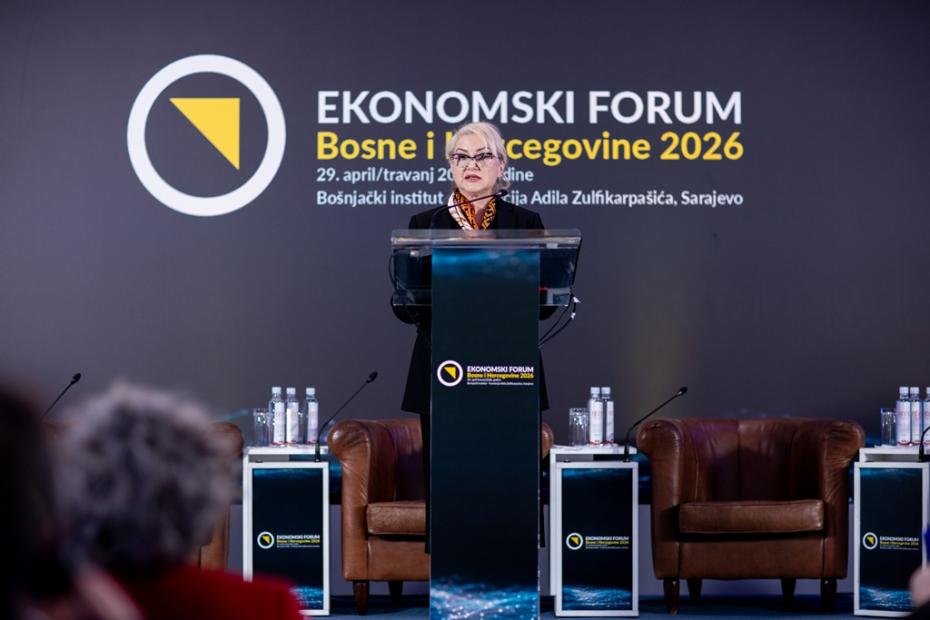


Energy Transition as a Path to Economic Growth and Sustainable Development
Sarajevo, April 30, 2026 – The Economic Forum of Bosnia and Herzegovina 2026 was successfully held yesterday in Sarajevo, bringing together policymakers, representatives of the academic community, international organizations, and the business sector with the aim of opening a dialogue on one of the most important topics of modern development – energy transition as a driver of economic growth and sustainable development.
The Forum was organized by the University of Sarajevo – School of Economics and Business, in cooperation with relevant domestic and international partners, and through two thematic panels provided a comprehensive overview of the regulatory, investment, and implementation aspects of energy transition in Bosnia and Herzegovina.
In her opening remarks, the Dean of the School of Economics and Business, University of Sarajevo, Prof. Dr. Meliha Bašić, emphasized that the Economic Forum of Bosnia and Herzegovina has evolved into a key platform for economic dialogue and for connecting knowledge, practice, and decision-makers. She particularly highlighted the role of educational institutions in the energy transition, noting that, in addition to transferring knowledge, they actively contribute to developing solutions through cooperation with the real sector. She added that this transformation requires an interdisciplinary approach, the development of new competencies, and continuous investment in knowledge, with the academic community playing an important role in building human capital and strengthening trust for the successful implementation of development policies.
The Governor of the Central Bank of Bosnia and Herzegovina, Dr. Jasmina Selimović, spoke about the importance of macroeconomic stability as a foundation for development: “Macroeconomic stability is not an abstract economic concept, but the foundation of everyday life for citizens, business security, and the long-term development of Bosnia and Herzegovina. A stable currency, trust in the financial system, and an independent Central Bank are key prerequisites for attracting foreign direct investment, particularly in the energy sector, which can drive a new industrial transformation of our country. Through the currency board arrangement, a stable exchange rate of the convertible mark, and responsible management of foreign exchange reserves, the Central Bank of Bosnia and Herzegovina preserves the predictability that investors require. Stability is not an end in itself—it is the basis for development, new investments, job creation, and stronger integration of Bosnia and Herzegovina into European and international markets.”
Chargé d’Affaires of the United States Embassy in Bosnia and Herzegovina, John Ginkel, addressed Forum participants via video message, expressing optimism about the country’s energy future and economic development. He emphasized that reliable and accessible energy is the foundation of long-term growth and highlighted the importance of the Southern Interconnection project as a strategic step toward greater energy security, diversification of supply, and increased investor confidence. As he noted, this project will help connect Bosnia and Herzegovina with regional and global markets, stimulate new investments, and create opportunities for industrial development and job creation, confirming the country’s potential to position itself as a regional energy hub.
The Minister of Foreign Affairs of Bosnia and Herzegovina, Elmedin Konaković, emphasized that projects such as the Southern Gas Interconnection represent an important development opportunity for Bosnia and Herzegovina. He highlighted that energy security and diversification of energy sources create space for new investments and stronger economic ties, contributing to a more stable and competitive economic environment.
The Permanent Representative of Bosnia and Herzegovina to the United Nations, Dr. Zlatko Lagumdžija, addressed the audience, pointing to the broader international context and emphasizing that energy transition represents one of the most significant development opportunities for Bosnia and Herzegovina. He noted that the transition to renewable energy is becoming a central element of economic policies and that Bosnia and Herzegovina has a real opportunity to position itself as a regional energy hub through investment mobilization and the development of large-scale projects, which bring multiple economic benefits—from new jobs to significant fiscal revenues.
Branimir Muidža, President of the Business Council of the School of Economics and Business and General Manager of Heidelberg Materials for Bosnia and Herzegovina and Croatia, spoke about the concrete challenges and potentials of Bosnia and Herzegovina: “Energy transition today represents a key economic issue. Bosnia and Herzegovina possesses significant natural resources, but system efficiency—particularly in the regulatory framework and the speed of investment implementation—remains a key challenge.” He also highlighted the importance of European mechanisms such as CBAM, which further emphasize the need for accelerated transformation in order to preserve the competitiveness of domestic industry.
Through two panels—the first focused on policies, governance, and regulatory reforms, and the second on concrete experiences and project implementation—participants exchanged knowledge and experiences and provided recommendations for improving the investment environment, accelerating procedures, and ensuring more efficient implementation of renewable energy projects.
Within the second panel, the President of the Management Board of ASA Bank, Samir Mustafić, emphasized that Bosnia and Herzegovina must provide stronger support to the private sector through renewable energy projects, which are key to strengthening the competitiveness of the domestic economy. He also highlighted the readiness of the banking sector to support these processes within a stable regulatory framework. Energy transformation represents a strategic opportunity that, through sustainable solutions, directly contributes to economic stability, enhanced competitiveness, and the long-term progress of the entire country.
It was concluded that Bosnia and Herzegovina has all the prerequisites for a successful energy transition, but that the key lies in accelerating the shift from strategic documents to concrete implementation, with complex administrative procedures remaining a major obstacle. Energy transition has been recognized as a development opportunity that can contribute to long-term stability, greater competitiveness, and sustainable economic growth.
The Economic Forum of Bosnia and Herzegovina 2026 once again confirmed its role as a relevant platform for dialogue and for connecting key stakeholders, with the aim of creating concrete solutions and strengthening the economic development of Bosnia and Herzegovina.
University of Sarajevo – School of Economics and Business