Successfully Implemented Project: "Predicting the Risk of Drug-Drug Interactions via Neural Networks"


How can pharmacy, artificial intelligence, and computer technologies be combined to ensure safer drug use?
This was precisely the goal of the project "Predicting the Risk of Drug-Drug Interactions via Neural Networks," co-financed by the Federal Ministry of Education and Science and implemented through collaboration between the University of Sarajevo – Faculty of Pharmacy and the Verlab Scientific Institute. The project leader was Dr. Naida Omerović Ćorović from the Department of Pharmacology and Clinical Pharmacology.
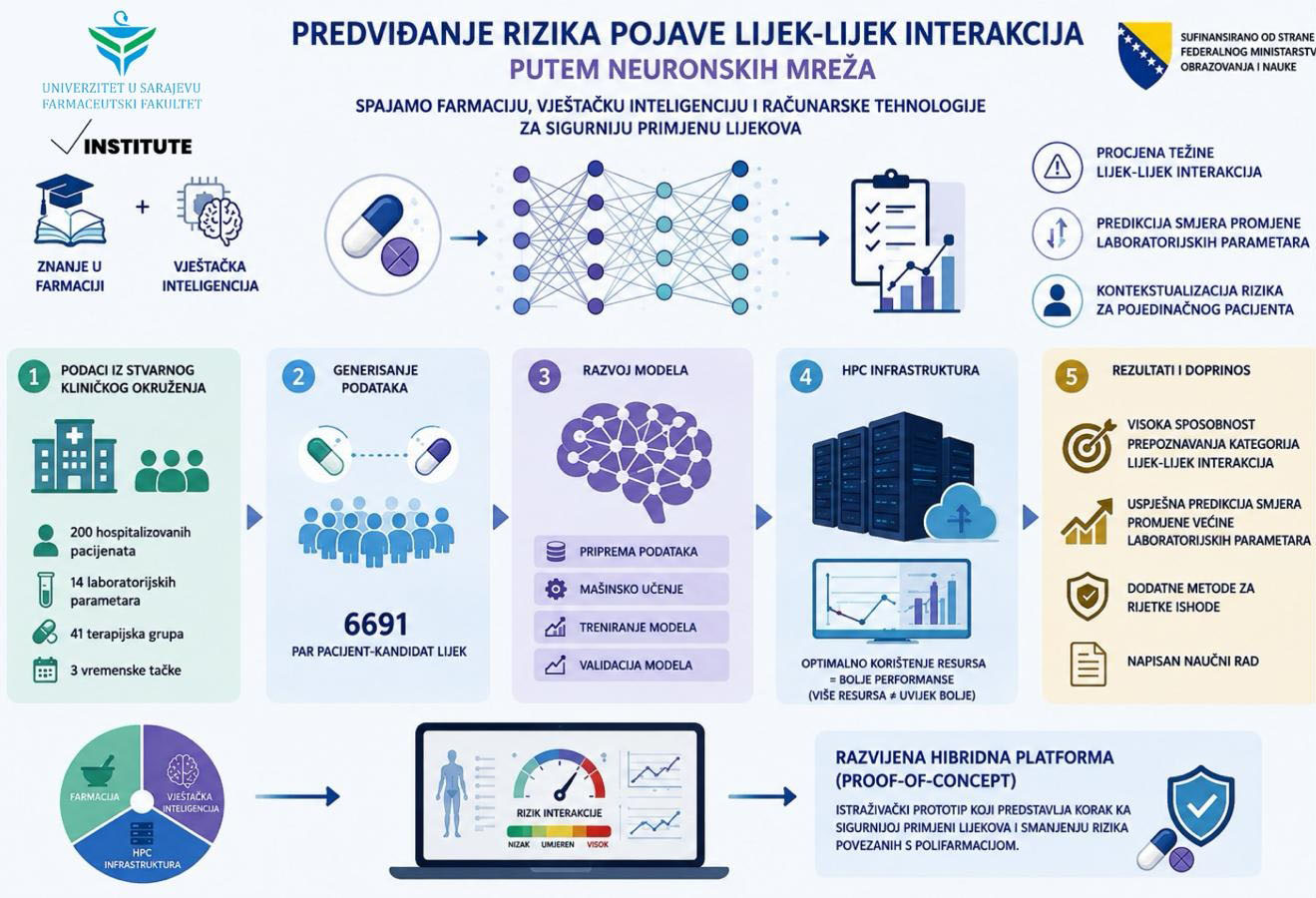
As part of the project, educational training was conducted at the Verlab Scientific Institute, covering theoretical approaches to neural networks, artificial intelligence methods, and machine learning, as well as practical work on high-performance computing (HPC) systems.
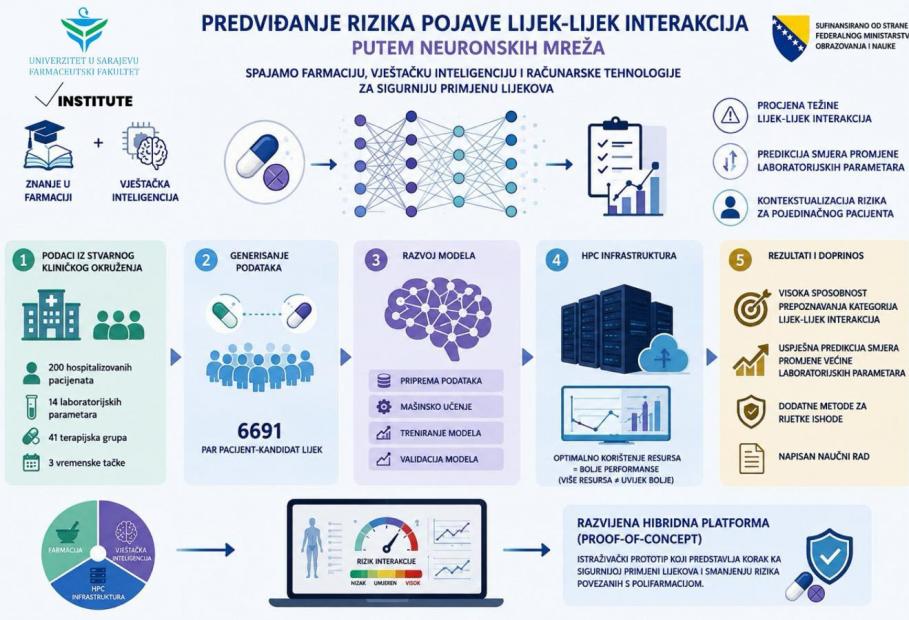
The most significant result was the development of a proof-of-concept hybrid platform that combines pharmaceutical expert knowledge with machine learning methods. The platform's objective is to assess the severity of drug-drug interactions, predict the potential direction of changes in laboratory parameters, and contextualize risks relative to individual patients.
The research included 200 hospitalized patients, monitoring 14 laboratory parameters and 41 therapeutic groups across three time points. A total of 6,691 patient-candidate drug pairs were generated.
The developed models demonstrated a high capability for recognizing categories of drug-drack interactions and successfully predicting the direction of changes in monitored laboratory parameters. For most laboratory parameters, the models showed optimal results, while rare outcomes required additional methods to improve prediction stability. A special segment of the project was dedicated to applying HPC infrastructure, demonstrating that increased computational resources do not always equate to better performance. Optimal use of HPC infrastructure depends on the characteristics of the specific research workflow.
One of the project's outcomes is a scientific paper based on the conducted research.
The developed platform represents a research prototype, not a finished clinical tool. This project represents a step toward connecting pharmacy, artificial intelligence, machine learning, and HPC infrastructure to develop new approaches for safer drug use and reducing risks associated with polypharmacy.